Showing posts with label Toyota. Show all posts

Friday, August 14, 2009

Toyota Supra (93-96)


The Toyota Supra is an amazing twin-turbo supercar that not only looks like a sci-fi space vehicle, it goes like one, too. The huge rear spoiler looks like it should improve rear traction and grip at high speed, and the ride is very firm. Supras are rare and very expensive to run, but the engine performance alone more than justifies the running costs. So, if you're after a stylish sportscar that goes like lightning, you could do much worse than joining the exclusive Supra club. Official UK cars were only available between 1993 and 1996, so anything registered outside of these date will definitely be a private 'grey' import.

Performance
With Ferrari-beating acceleration, the Supra boasts a top speed and delivery that is unbelievably effortless. The engine purrs innocently, providing no real clue to the potentially mammoth power that it possesses. Although the gearchange is heavy and notchy, the six-speed manual three-litre twin turbo has an top speed limited to 155mph, accelerates from 0-60 in under five seconds and feels like it will keep pulling relentlessly.

Handling
The Supra handles surprisingly well for a big car, with generally good traction – helped massively by the vehicle’s weight and large rear wing - though the back end can twitch through twisty bends. The agile and sophisticated chassis design ensures that the ride is comfortably smooth, plus the steering feedback is fantastic, giving you a real feel of the car’s capabilities.

Comfort

The air-conditioned cabin is snug enough for two, but passengers in the rear may find it a bit of a squeeze, due to the shallow sloping rear window and shelf-like seats. The leather-upholstered seating is very soft and gives great support, while the nice fascia encompasses a wealth of nifty gadgets and gizmos. The sporty suspension is a touch too firm however, causing the ride to be a little uncompromising over long distances.

Practicallity
The three-door design makes rear access a little awkward, although the Supra’s back seats aren't best suited to frequent family use anyway. There is a reasonable level of boot space and it is sufficiently large enough to easily accommodate the weekly shop or holiday luggage. The Supra is simply too powerful for mundane, inner city driving - behaving like a bull in a china shop if faced with urban congestion – so keep it to the A- and B-roads to maximise its performance capabilities.

Equipment
The twin-turbo Supra from 1993 has rear-wheel drive, a limited-slip differential, independent suspension, and traction control. Six-speed manual transmission is standard, and four-speed automatic transmission was optional. Equipment includes a large body-coloured rear spoiler, circular rear lights behind flush lens, front spoiler with large front air intakes, five-spoke alloy wheels, cruise control, electric driver’s seat adjustment, heated front seats, leather upholstery, leather-rimmed steering wheel. A high-level brake light and CD autochanger were added in October 1994

Behid The Wheel.
The driving position is reasonably good, though there are a few blind spots that could make overtaking and reversing a little awkward, caused by the thick rear window columns and obstructive bulky spoiler. Everything within the driver’s grasp is clearly arranged, while the leather rimmed steering wheel and electrically adjustable driver’s seat give a great sense of sporty style.

Safety
Reassuringly, all models come with power steering and ABS as standard, as well as twin airbags and traction control. The remote alarm and central locking system seems to be up to the task of deterring thieves, but fitting a tracker advice might keep the insurers somewhat happier, as these cars tend to attract a lot of attention.

Reability
apanese manufacturers tend to epitomise the term 'dependability' and Toyota are no exception to the rule. Superbly engineered, the Supra is generally very reliable if properly maintained. Specialist or main dealer servicing is essential for reliability and to retain value and saleability, as there's an awful lot of specialist and highly stressed machinery involved that should have been well looked after.

Car check problem points

Body: Watch out for crash repairs.

Engine/Gearbox: There's an awful lot of specialist and highly stressed machinery involved, so full Toyota service history is essential.

Other: General abuse and neglect.

Sunday, February 15, 2009

Toyota iQ iQ2

picture of car from the front

Short front overhang highlights the iQ's compactness

Ratings

Overall Rating 9Overall rating

Value for money Rating 9Value for money

Space and Practicality Rating 10Costs

Space and Practicality Rating 9Space and practicality

Controls and display Rating 8Controls and display

Comfort Rating 8Comfort

Security Rating 7Car security

Safety Rating 8Car safety


Likes

  • Cheeky looks are appealing
  • Superb space efficiency throughout
  • Comfortable and easy to drive
  • Attractive cabin, well specified

Gripes

  • Not a car for all people at this price
  • More cabin colour choices would be welcome
  • Boot space is negligible with four people on board
  • No diesel option for UK

Toyota already has a strong reputation as a builder of excellent small cars, with the impressive Aygo and spacious Yaris in its range. However, it now has a third string to its bow with the introduction of the iQ, which it claims offers unique advantages in the small car segment due to its size and packaging.

In many respects the Toyota iQ follows the conventional layout for a small car. It has a small petrol engine mounted transversely in the front of the car, driving the front wheels through a manual or automatic gearbox. However, the difference in the iQ is in the details. At 2,985mm in length, it is currently the only car available less than three metres long that can accommodate four people in comfort.

The iQ achieves this through some remarkable packaging ideas, all of which contribute to maximising the interior space. Mechanically, alterations to the differential, steering mechanism and air conditioning unit allow the compact engine to be moved further forward, while the asymmetric dashboard means the front passenger seat can be moved much further forward, increasing rear passenger space.

The result of this space-saving initiative is that the iQ can fit four adults inside, although the seat behind the driver has the most restricted legroom. In four-seat configuration the boot space is understandably miniscule, but with three or two occupants there is a much more usable amount of storage space. Another huge benefit of the iQ's size is manoeuvrability: its turning radius of 3.9 metres is extremely compact.

Rather than a budget city car, the iQ is designed to be a second or third family car, and rather than being a stripped-out, low budget machine, it has many features expected of cars from a higher price bracket. All models have air-conditioning, remote central-locking and ESP as standard, while the higher grade iQ2 model adds items like climate control, keyless entry and start and automatic headlights and wipers.

Our verdict on the Toyota iQ iQ2

The Toyota iQ is a genuinely new kind of car, offering spectacular space efficiency and usability but with a distinct premium feel and strong equipment and luxury. In terms of pure pricing it is more expensive than some rivals, but in terms of what it offers and is capable of, it actually offers good value for money.

Costs
Costs rating 10

Although the initial purchase price may seem high, running costs are likely to be spectacularly low. Insurance costs will be very low indeed, while the 1.0-litre manual model is exempt from Vehicle Excise Duty thanks to its sub-100g/km emissions rating.

Space and practicality
Space and Practicality Rating 9

The iQ does a remarkable job of offering lots of space in a compact silhouette. Those in the front seats are very well catered for, with excellent head and legroom - even elbowroom is better in iQ than in the bigger Yaris. In the back, taller adults may struggle a little for space, but most people will find sufficient room for long journeys.

picture of car from the rear

Unusual styling is best appreciated from the rear

Controls and display
Controls and Display Rating 8

The layout of the iQ is very impressive, as it shows some novel thinking in the pursuit of increased space. The instruments are attractive and easy to read, while the clever rotary air-con control combines the functions of several buttons and switches. The optional sat-nav system is also clear and easy to use.

Comfort
Comfort Rating 8

Comfort levels in the iQ are surprisingly good. Refinement is excellent, with impressively low noise levels. The ride quality is also surprisingly good considering the car's length and only the worst bumps get through to the cabin.

Car security
Security Rating 7

All models have locking nuts on their standard alloy wheels, remote central locking and an engine immobiliser as standard, which should offer sufficient security for a car of this nature.

Car safety
Safety Rating 8

The iQ packs a remarkable nine airbags into its shell, including a world first rear curtain airbag, to protect passengers in the rear seat who are close to the car's extremities. The high safety specification including ESP on all models is a welcome sight.

Driver appeal
Driver Appeal Rating 7

Anyone expecting the iQ to drive like a low-budget small car will be in for a surprise. From the driver's seat it feels like a much bigger car, with a good view out, an excellent driving position and smooth controls. Despite its modest output the 1.0-litre engine is keen and smooth and makes the iQ an enjoyable car to drive.

picture of car interior

Cabin shows a high level of quality

Family car appeal
Family Appeal Rating 7

The iQ does have the ability to perform family duties, as long as the combination of four people and luggage is not a common one. Child seats can be installed in the rear, and children are bound to find the iQ more exciting to be in than a conventional family hatchback.

First car appeal
First car Rating 9

The iQ is possibly a little expensive for many first time buyers, but in respect of its dimensions and ease of driving it makes for a perfect first car.

Quality and image
Quality and Image Rating 8

The iQ offers the kind of quality expected of a car in a bigger class: although it is close to Aygo in terms of size the cabin is closer to Auris or Avensis than anything else. The iQ's image is dominated by its unique design. This gives it strong appeal for the fashion-conscious and puts it outside of Toyota's normal appeal.

Accessibility
Accessibility Rating

The iQ may be small, but the large doors make it easy to get into the front seats. As for the rear, the fact that the passenger seats slides forward a long way makes access relatively easy, although passengers getting in from the other side have more of a squeeze.

Stereo and ICE (In car entertainment)

The optional upgrade system on the iQ2 includes a connection for MP3 players and delivers very good sound quality, helped by the good refinement. The single joystick control mounted on the steering wheel is very simple and easy to use.

picture of car in detail

Clever design allows two seats in the rear

Colours and trim

The iQ's bold exterior shape benefits from stronger colours, looking especially attractive in white. Inside the iQ has a mix of greys and browns, which is attractive and unusual although its clever design would benefit from brighter hues. The quality of the trim itself is very good.

Parking

The iQ is at its best when it comes to parking thanks to the excellent visibility, tiny dimensions and large amounts of steering lock. Optional rear parking sensors make it easier still.

Spare wheel

A tyre repair kit is fitted as standard.

Range information

Petrol engine options - 1.0-litre (67bhp); 1.33-litre (100bhp). Transmission options: Five-speed manual gearbox, CVT automatic gearbox. Trim levels: iQ, iQ2

Wednesday, May 7, 2008

2009 Toyota Corolla Road Test Review


The ninth generation of Toyota Corolla was not so much old, though it definitely had outstayed its welcome, as it had become boring. If fact, say that bo-ring, with the emphasis on the first syllable, as in Beauregard. Not grammatically correct, perhaps, but more exciting to talk about than the Corolla was to drive.

Not that economy cars have any right to be exciting or even entertaining, but there’s no reason why frugal wheels must be Exhibit A in a mattress commercial. And that’s what the Corolla had become: a rolling snooze. Need any more proof? Scion is Toyota’s confession that its smaller offerings had induced enthusiasm comas among the young.

Of course, the team working on the tenth generation Toyota Corolla could have yielded the field to Scion, but that also would have left Corolla’s market share open to poaching by competitors and left themselves contemplating unemployment.

So instead of another generation of generic econoboxes, Toyota pulls the wrap from a 2009 Corolla that’s surprisingly striking for an economy sedan from the company whose logo is the man wearing a sombrero.

Indeed, the 2009 Corolla is no box, econo or otherwise. While not as daring as the Honda Civic, the Toyota has a few styling flourishes of its own including a chic drooping snout behind a wide grille. A neat feature is how the Toyota logo suspended from the leading edge of the hood is matched by an indent in the lower edge of the grille surround, certainly a result of some designer’s aha! moment.

Toyota breaks with boring design with organic crests growing atop the hood, leading not to the shoulder line but to the A-pillar. The clear-covered headlamp array contours back to the front fender and down along the side of the vehicle. Toyota kicked the base of the A-pillar forward for a “faster” windshield and gave the backlight a flatter angle as well. The shape of the trunk continues the shoulder line with a step along the rear flanks, similar to Volvo but with clear red taillamps that project from the body.

The 2009 Corolla has five trim levels: standard, LE and XLE, and the sporty accented S and the high performance—relatively speaking—XRS. The latter two have “ground effects” trim along the rocker panels and under the rear bumper, plus “sideburn” (our term) spoilers on both front corners.

The interior matches the exterior. Plain it’s not but it doesn’t have the sci-fi dash like the Civic. Instead, the instrument panel is topped by a double curved cowling matching the large, legible speedometer and tachometer. The steering wheel has tilt/telescoping as standard equipment on all trim levels, as are XM satellite radio ready audio, air conditioning, front seat side and side curtain airbags, intermittent wipers and 60/40 split folding rear seats. The price leader “standard” model has hand crank windows; to get central locking means moving up to the LE trim level. At the other end of the Corolla sedan spectrum, the XLE includes variable intermittent wipers, center console, wood grain trim and fancy “optitron” gauges, also used on the XRS. The latter is Toyota simply putting your money where your eyes are.

The S and XRS have front sport seats, cruise control and a leather-trimmed steering wheel. The XRS improves sport driving with 17-inch alloy wheels with P215/45R17 tires, rear disc brakes to replace drums, and a strut tower brace to stiffen the chassis for better handling. The XRS also has stability control standard, otherwise optional on all trim packages.

The exterior dimensions of the 2009 Toyota Corolla increased by less than a half inch in length and just short of 2.5 inches wide while decreasing about 1 inch in overall height while maintaining the same interior space. The greater width yields increased shoulder room and Toyota says there’s more room for an over-six footer to sit in comfort…which we can’t confirm because we aren’t over six foot, but folks, can half an inch more legroom make that much difference?

Toyota also says it gave special attention to wind noise around the A-pillar, plus a five-layer acoustic glass windshield, with two layers of glass sandwiching a layer of acoustic material. Side window vibration was also reduced and the carpeting was modified for better sound insulation.

A choice of two new engines comes with three different transmissions. An all-new 1.8-liter 16-valve four doesn’t skimp on technology with variable valve timing on the intake and exhaust sides. The result is an impressive-for-its-size 132 horsepower and 128 lb-ft of torque. A five-speed manual transmission is standard with a four-speed automatic optional. The automatic has hill sensing technology which, based on throttle position, vehicle speed and acceleration, determines whether the car is going up or downhill and selects gear ratios accordingly, including shifting down on downhills for moderate engine braking.

The other engine is Toyota’s 2.4-liter four, though completely redesigned for use in the Corolla. It’s rated at 158 horses, but it’s the gain in torque that makes the bigger engine worthwhile. At 162 lb-ft, the extra grunt improves acceleration and around-town drivability. It too comes with a 5-speed manual as standard equipment but the optional automatic is a five rather than four-speed.

We had the opportunity to drive two Corollas, one with the 1.8-liter and four-speed automatic, and the other with the 2.4-liter and the manual shift five-speed in an XRS. They were about as far apart on the Corolla spectrum as possible, as was the performance. Simply put, although the 1.8-liter was smooth and quiet, at full throttle it had a raspy exhaust note. Performance was more an accumulation of velocity rather than acceleration.

The automatic shifted smoothly but it gave the impression of soaking up torque like California absorbs rain…when it finally does, rain in California, that is. On the highway it feels like the transmission, although in drive, was left in an intermediate ratio. It sounds like the engine wants to be shifted up, except there’s nothing more up to shift up to.

Corolla drivers will find the handling comfortable and familiar. A soft ride compromises ultimate cornering but the Toyota is confident up to its limit, with plenty of warning before it’s reached. We do recommend the stability control, however, to keep things on the up and up...literally.

Performance of the XRS was pleasantly perky, and casual driving took a lot less throttle to accelerate away from traffic lights without feeling like a traffic cone with wheels. The five-speed manual was reasonably crisp and didn’t suffer from synchronizer lockup when revved to its redline. Not, of course, that the forces are that great to begin with. Still, it scoots entertainingly and with more security than lesser Corollas, thanks primarily to the lower profile tires with less sidewall squirm. What the XRS lacks is a true sport suspension with firmer springs and shocks and well-sorted anti-roll bars.

The Corolla XRS, to that extent, is sort of an odd bird. It is, according to a Toyota spokesman, not a car one seeks out for its own characteristics. Rather it’s something that someone who has already decided on a Corolla will spec up to as better than an ordinary Corolla. Perhaps. Still, Toyota expects about five percent of Corolla sales to be the XRS.

Whatever trim level, we see the tenth-generation Toyota Corolla as a significant improvement over its predecessors (though not so much in quality because there was less room for gains there). The 2009 Corolla rescues the model from the mundane just when its competitors are spicing up their mainstream econocoaches. Bo-ring? Not now. Not if you don’t want it to be.

Friday, May 2, 2008

Toyota Corolla Altis 2008

Road Test – Toyota Corolla Altis 2008
Toyota has been selling Corollas since the 60's. Despite serving the masses well, it’s painfully uninspired, and its designs have become somewhat of a numbing norm. Now in its 10th incarnation, it shares similar engines with the previous model. Can it hold a candle to the stylishly popular Honda Civic or the aggressively fashioned Mitsubishi Lancer?


You wouldn't be able to guess what it is from a distance. In fact, you’d be forgiven for thinking it was a Camry. Great! Toyota has taken hints of its large sedan and slapped them onto the new Altis, mainly in the form of the car’s front grille and headlamps.

And that’s the first impression we get with this new model. At last, a little visual justice has been done to this icon of daily, workhorse transportation. After proving to be the definitive, popular choice of Singaporean families, Toyota has made it even more irresistible to own one with their current offspring.

Exterior

At 20mm closer to the ground and almost 60mm wider than its predecessor, the new Toyota Corolla exudes a much younger and sportier nature. The soft, distinct lines cut and define their way from front to rear as they flow over the headlamps, past the bonnet and running the length of the sides before gently dissolving at the trunk. Toyota calls this modelling process a “Sweep Cut”, which is basically one of their forms of car sculpting.

So it has character. Even more than the past few Corolla's combined. But like everything else, something had to give, and that came in the form of the back-side of the car.
The odd shaped tail lamps seem to be a compromise between that of the Camry's and the older Altis'. This somewhat dampened the excitement that the front conveyed. Even the circular reflectors embedded in either side of the bumpers were a little off, and reeked of last minute placement.

To get our minds off that, Toyota distracts by pointing out that in their bid to contribute to a greener environment, they have reduced the amount of environmentally harmful substances used in the production of their cars. Materials used in parts like silicon weather stripping and the blackout portion of the door frame and roof moulding have been substituted with less harmful materials.

The result? 80% less Volatile Organic Compounds in the atmosphere as compared to the previous model. No wonder it cost almost a billion yen to develop…


Interior

You are greeted by a neat, uncluttered dash together with a beige colour scheme - easy on the eyes with a sense of calm, overriding any form of negative energy. The centre console's various buttons are distributed well, and are all within the reach of the driver.

The rest of it is pretty much standard issue - an updated steering wheel with audio control buttons, CD player, a graphic audio interface and climate control.

Keeping with the trend, the steering wheel has been updated as well. Audio & Multi-Information Display switches have been installed so you can change the radio station when an annoying Britney rendition plays for the umpteenth time. Another pleasant surprise was telescopic adjustment that allowed us to pull, or push the wheel away, effectively adjusting its reach with relative ease.

The seating position and comfortable support of the seats kept us happy throughout our test drive. This was carried over to the rear seats as well. With added width and strategically placed C Pillar, more space has been granted with the ability for to swallow 3 adults easily at the back.

A total absence of the typical “hump” in the rear flooring area is a breath of fresh air consequently, sliding around is much easier, if you fancy that sort of thing.

The 475L boot manages 4 golf bags and a bunch of smaller items with ease. The glove box has 2 separate compartments on top of each other - a novel way to utilise space. Not only can it store more items but we found ourselves opening and closing it in fascination. Although it lasts for all but the first 7 times, it’s a cool distraction piece for passengers who talk way too much while you drive.


Engine & Driving Impressions

Both engines have been retuned to comply with stringent Euro-3 emission control regulations, and while power hikes aren’t a priority, they are a little more fuel efficient. The straight-4, 3ZZ-FE spec in the 1.6l produces 145Nm of torque at 4400 rpm while putting out a respectable 107bhp. The more powerful 1.8l 1ZZ-FE found in the SS1 model Celica and the Wish, squeezes 170Nm of torque at 4200rpm with 130bhp on tap. Both models come in a four-speed automatic transmission, with the 1.8l featuring a sequential gear shift facility.

We test drove the mainstream 1.6-litre variant, and despite relatively mediocre power figures, there is enough pulling power to make overtaking a breeze should you decide to floor the loud pedal. Lane change-acceleration capabilities aren’t a problem at all, even with the whole family piled into the car.

Coming to an abrupt stop is efficiently facilitated by the 15'' ventilated discs up front and solid discs at the back. Wind and road noise hardly exist below 100km/h but when you bury the accelerator into the carpet, the engine whimpers for a second before a loud, disgruntled roar makes itself heard. Then, you’ll see the speedometer needle move rapidly to the right. Even as legal limits are breached, noise, vibration and harshness levels were kept low whilst comfort levels were hardly compromised by Corolla standards.

The McPherson struts (front) and torsion beam (rear) both do their job well in keeping occupants focused on their own thing while driving, although all of us agreed that high speed stability could have been better, especially with the overly-assisted steering. Humps didn't prove to be too jarring when driven over at higher than recommended speeds.

Despite the mysterious decision to not include a multi-linked rear setup commonly found in cars its class, this new one actually handles slightly better, if not the same. It dives willingly into corners and turn in is precise. When pushed, heavy understeer rears its ugly head at this car's relatively low limits of grip, as might be expected of it.


Why buy it?

With a slew of safety features like a reinforced cabin, dual airbags, brake-assist, anti-lock brakes, electronic brake-force distribution and an anti-theft System, all of which comes as standard.

Obviously, the new Corolla Altis will have to put up a fight against the Mitsubishi Lancer EX 1.5 Sports which is almost $5,000 cheaper and slower ($63,988 as of 20 Mar '08). Then there is the Mazda 3 with its continental car-like stability and the Honda Civic with its funky interior, with the latter being the most expensive, and value-scarce car.

The base 1.6L currently retails for $67,388 with the most expensive and highly equipped 1.8L at $76,988 as of 21st March 2008. Not exactly the cheapest car, but that price tag is certainly justified once you are behind the wheel. It has more mass appeal now than ever with its handsome, grown up looks and it has to be said, that everything else about this car has grown with it.

Tuesday, April 22, 2008

TOYOTA Corolla Matrix 2.4 supercharge Rally Sport..

I've received this email from my freinds yesterday, so i wanna share with all the readers here.

Supercharged? Check. Intercooled? Big time. 19" Wheels and beefier brakes? You know it. Diffuser? Apparently. Hood scoop? Yeah. Roof scoop? Hell yeah. Why, it's the new Toyota Matrix Rally Sport.As with the 2009 Corolla Sedan, Toyota presented a concept version of the 2009 Matrix at the 2007 SEMA Show in Las Vegas. The Matrix Rally Sport is a racier interpretation of Toyota 's 5-door crossover powered by a supercharged version of the stock 2.4-liter four-cylinder engine. The concept is equipped with a full roll cage, body kit, hood and roof scoops and 19-inch OZ alloy wheels white the stripped out interior features a set of racing bucket seats.

2009 MATRIX PRELIMINARY SPECIFICATIONS

POWERTRAIN
1.8-liter four-cylinder engine
132 hp @6,000 rpm
128 lb.-ft. of torque @ 4,400 rpm
Five-speed manual and Four-speed automatic transmissions

2.4-liter four-cylinder engine
158 hp @ 6,000 rpm
162 lb.-ft. of torque @ 4,000 rpm
Five-speed manual and four and five-speed automatic transmissions

DIMENSIONS (inches)
Overall Length: 173.0 (S and XRS grades)
171.9 (Standard grade and S all-wheel-drive grade)
Overall Width: 69.5
Overall Height: 61.4 (XRS and S all-wheel-drive grades)
61.0 (Standard grade and S)
Wheelbase: 102.4
Ground clearance: 5.3 (S and XRS grades)
5.8 (Standard grade)

October 31, 2007 - Las Vegas - Toyota Motor Sales (TMS), U.S.A. , Inc., unveiled the all-new second-generation Corolla Matrix at a press conference today at the 2007 Specialty Equipment Market Association (SEMA) Show.
The Toyota Matrix, the sporty five-door vehicle that helped redefine the concept of a crossover utility vehicle, has been redesigned for the 2009 model year to offer performance that matters for driver enjoyment.
"The Matrix concept was based on blending the functionality of an SUV, the style, image and performance of a sports car with the affordability of a subcompact sedan," said Tim Morrison, Toyota Division corporate marketing manager. "For 2009, it's all that, and more. It may have the body of a five-door hatch, but it comes with the soul of a two-door sports car."
Development of the 2009 Matrix focused on greater exterior coupe-like styling with enhanced interior utility and improved dynamic performance. It was made wider with a lower stance than the current model while maintaining its interior space. The result is a sporty, dynamic shape that contains room for five people to ride in comfort. As a result of significant changes to the Matrix's profile, the theme is flowing and dynamic. The design expresses a low center of gravity, and coupe-like style with a fun-to-drive image. From the rear, the Matrix has rounded rear windows and continuous character lines that run from the front grille to the A-pillar.
Matrix will be available in three grades - Standard, S and the XRS. And Matrix will offer the option of all-wheel drive (AWD) with the S grade. The S and XRS models integrate a front underbody spoiler with a large mesh fog lamp bezel and rear underbody spoiler. A rear deck spoiler will be standard for all XRS models.
The Matrix interior is completely redesigned to enhance driving enjoyment, comfort and utility.
Seats have been redesigned to accommodate the vehicle's new lower profile while maintaining the expected high comfort levels, and seat positions were lowered slightly to maintain appropriate headroom. As a result, cabin space remains equal to that of the previous Matrix.
A new three-spoke steering wheel enhances the rest of the new Matrix interior. XRS models come standard with a leather-trimmed steering wheel that also includes spoke-mounted audio controls and hands-free Bluetooth(r) capability when equipped.
The driver and front passenger are treated to comfortable new sport seats, with seat-mounted side airbags. A fold-down seatback table will be available for the front passenger's seat, enhancing interior utility on S and XRS. A movable and removable cup support element for the front center console helps provide versatile storage area and convenience. The cup holder area can be used as a tray when the divider is removed.
For rear-seat passengers, expanded front-to-back couple distance helps to provide additional room and comfort. A folding seat with a 60/40 split includes a middle-seat headrest for the fifth passenger.
The Matrix is equipped with a new, high-efficiency air-conditioning system with larger vents for directional accuracy and offers reduced power consumption and improved heating and cooling.
The 2009 Matrix offers the choice of two different engines, a five-speed manual transmission, and either four- or five-speed automatic transmissions.
A 16-valve, 1.8-liter four-cylinder engine will produce 132 horsepower at 6,000 rpm and 128 lb.-ft. of torque at 4,400 rpm. The engine will feature Dual VVT-i (Variable Valve Timing with intelligence) on both the intake and exhaust camshafts that helps it achieve outstanding performance and economy.
Estimated EPA fuel economy ratings are 26/32 city/highway mpg for manual transmission models and 25/31 for the automatic transmission model powered by a 1.8-liter engine.
For those who crave just a bit more horsepower and torque, the Matrix offers a 16-valve DOHC 2.4-liter four-cylinder engine with VVT-i that will produce 158 horsepower at 6,000 rpm and 162 lb.-ft. of torque at 4,000 rpm.
Matrix models powered by the 2.4-liter engine with five-speed automatic transmission will have an estimated EPA fuel economy of 21/29 city/highway mpg.
The Matrix's base wheel is a 16-inch steel unit with a six-spoke full wheel cover. A distinctive 17-inch five-spoke aluminum wheel will be available for the S grade, and an 18-inch aluminum alloy wheel with a twin five-spoke design will come standard on the XRS grade.
Dual-stage SRS airbags will be standard for the driver and front passenger. Front seat-mounted side airbags, two-row side curtain airbags and front active headrests are also standard.
Brake performance will be improved with standard front and rear disc brakes on all Matrix grades. Anti-lock brakes (ABS) with Electronic Brake Distribution (EBD) are also standard. Vehicle Stability Control (VSC) with TRAC and off switch will be standard on XRS and available as an option on all other models. VSC automatically adjusts engine output and the vehicle's braking force at each wheel when the vehicle experiences a loss of traction during cornering.
Form, fun and functionality will be in abundance with an array of standard convenience features across all three grades. Base equipment on all Matrix models include power color-keyed outside rearview mirrors, power steering, tilt and telescopic steering wheel, daytime running lights, heavy duty rear window defogger, intermittent windshield wipers, 12-volt power outlet, four cupholders, auxiliary audio input jack, front center console box and an engine immobilizer.
The S grade adds standard power door locks and windows with one-touch down driver-side, 115-volt power outlet, cruise control, intermittent rear window wiper, fold-flat front passenger seat, remote keyless entry, AM/FM/CD with MP3 capability and six speakers, front and rear underbody spoilers and fog lamps.
In addition to these features, the XRS grade features standard P215/45 R18 tires on 18-inch alloy wheels, sport strut tower brace, VSC with TRAC and off switch, and a three-spoke leather-trimmed steering wheel with audio steering wheel controls.
In addition to the array of standard equipment, an impressive list of optional comfort and utility features are available to further enhance the Matrix driving experience. Available options will include an AM/FM/CD with six-speaker system with DVD navigation with XM NavTraffic(r) capability, alloy wheels, power heated outside rearview mirror, intermittent rear window wiper, cruise control, power door locks, power windows, and remote keyless entry.
The all-new Matrix will hit Toyota dealerships in February 2008.

Friday, April 6, 2007

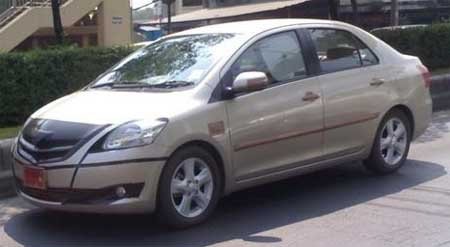
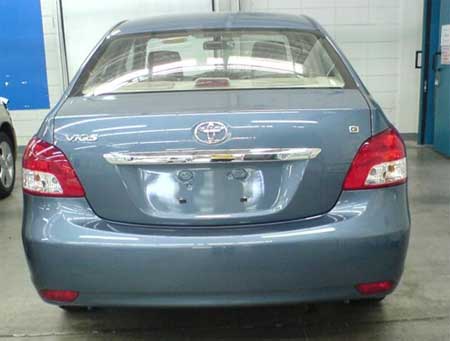
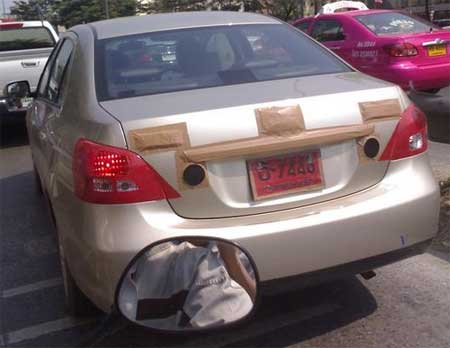
2nd Generation Toyota Vios in Malaysia?


Rumour is that the new 2nd generation Toyota VIOS on our market will also offer a 1.3 liter version priced somewhere between the Perodua Myvi and the VIOS 1.5 liter, about 65k or so, which will definitely prove to be a Proton killer. But then again, rumours and word of mouth shall remain just that, just rumours, until any official announcement or press release. There are plenty of rumours going around of so-called pending new models to be released soon, they usually center around the Nissan Note and the Toyota Ractic being offered at impossible RM4x,xxx price ranges.


After New VIOS launched in Thailand on 9 March 2007. The rumors already arrived Malaysia for the same reason. Is it will be true just wait and see unless there is official announcement or press confrence nothing can be confirm.

Pix credit to Paultan